
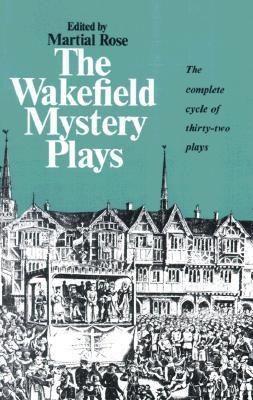
I came to read this play only because (thankfully) I found myself sitting in a class I had once sworn I would never take. That module was everything that I did not like.
Medieval.
Drama.
First of all, I did not find Medieval Europe to be in any way interesting because I simply can’t relate to a history I have no place in. Being the tropical-brown-skin-neither peasant-nor aristocrat-three-times-colonised-asian-bilingual-sometimes-speaks-broken-singlish-woman-in-her-20s I am, nope, I can’t relate! Second of all, I am also not a huge fan of drama (theatre) being taught in class, but did I sit through the class anyway? YES. Did I enjoy it? I think that is pretty self-explanatory in my attempt to write a review on one of the plays I read for the module.
So this particular play titled “The Crucifixion” comes in the collection of “The Wakefield Mystery Plays” and, as the title itself suggests, it dramatises the crucifixion of Jesus Christ. The play opens with a speech by Pontius Pilate, followed by the torturers leading Jesus to Calvary, and concludes with a speech by Nicodemus, which alludes to the resurrection of Christ, “That Lord that died for thee/ And rose on paschal morn”. Hence, it is evident that the entire play spans an extremely short timeframe (which means a short read).
Now, you might ask why I find myself so drawn to a narrative that has been told and retold across generations and continents. After all, anyone who has grown up with even a passing awareness of the cultural and social landscape around them is likely to know the story of Christ and His crucifixion. So what did this play do so differently to make me lock my luck in a module I did not want to take? It was the pain. The simplest, purest, and yet the most intense sense of pain. Whether you are 20 or 80, Asian or Hispanic, we all know pain well enough. It might differ in degree and in intensity, but we all have been there because it is human to feel pain.
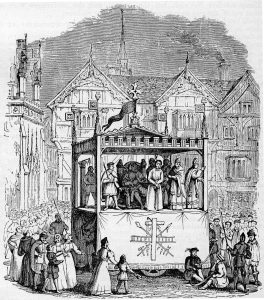
The play Crucifixion dramatises pain as I have never seen anywhere else before. It is the pain of Christ as the nails drill through his skin to the bone to the skin to the cross. He speaks to the audience, to us, through the fourth wall: “Behold if ever ye saw body/ Buffeted and beaten bloody/ Or thus dolefully to die”. It is the pain and the utter helplessness of being just a spectator when the torturers mock him: “ye call yourself a king/ You must prove a worthy thing”. You may find yourself overcome with the urge to cry out at the torturers, “How can you not see? He is the King, the Son of God! How dare you treat Him so cruelly?”, desperately wishing they would stop inflicting such pain upon Jesus. It is the pain welling up in your eyes and bursting at last when Christ speaks up: “My folk, what have I done to thee/ That thou all thus shall torment me” “What kindness further could I do?/ Have I not done what I ought to,”.
Wipe ye nose, thy play hasn’t end’d yet! (supposed comic relief. There wasn’t any in the play, so I am giving you one.)
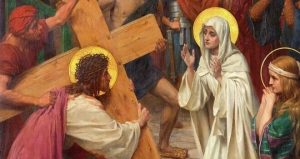
Just when you think you are done sobbing, when Jesus falls silent on stage, the second wave of emotions will wipe you off the shore and will carry you to the deep ends in the sea of sorrow and pain (You will be drawn). That is when Mary appears. The Mother. Whatever pain and sorrow you may have experienced earlier, as Christ was nailed to the cross, will seem but a prelude to the emotional anguish that awaits you now. For in this moment, you are drawn into the heart-wrenching agony of a mother forced to watch her own son being publicly crucified, condemned as a traitor, and branded a thief by the blind. She starts speaking, “My flesh that I have fed,/ In life lovingly led,” as she watches the crimson blood stain the body of her child, the child she once raised, fed, and gave birth to, her very own flesh. She is not consoled by the words of John. She proceeds, “Alas, my lamb so mild, why wilt thou leave me so?” she asks, “Wilt thou thus from me go?”
As you flip through the rest of the play in a blur, Nicodemus’ promise of Christ’s resurrection will put you slightly at ease, like a pat on the back. Yet, even after turning the final page, the play leaves you with a bittersweet aftertaste, as you walk away carrying two emotions in equal measure: an overwhelming sense of love and a profound sense of sorrow. These emotions linger, intertwined, for Christ, for Mary, for motherhood, and for humanity itself.
Sit in classes you swore you would never take, once in a while. You might as well stumble upon something that you end up writing a review about.
A small note: The Play Wakefield’s The Crucifixion, at the end of the day, is a work of fiction, and I am fully aware that certain theatrical interpretations may deviate from the original theological narrative. On behalf of the playwright, I sincerely apologise for any representations that you may find inauthentic or inconsistent with the source materials.