


There is something I own that I have spent countless years trying to improve. I have compared it to other people’s, shamefully hidden parts of it, and tried to make it more impressive, more acceptable, more beautiful to fit into a so-called “standard”. I had even wondered in the past, rarely, whether I should replace the whole damn thing and start again completely fresh.
The strange part? Nobody ever really asked me to (well, except a few)
Still, somehow, I became its harshest critic.
So to be honest, it started innocently enough. A comment here. A comparison there. Someone being better at something I cared about deep down. Someone being more confident, more attractive, more successful. Someone laughing at something I was insecure about at one point in my life. None of these things were supposed to mean very much in a general perspective.
But the human brain has a really funny way of turning small moments into permanent evidence.
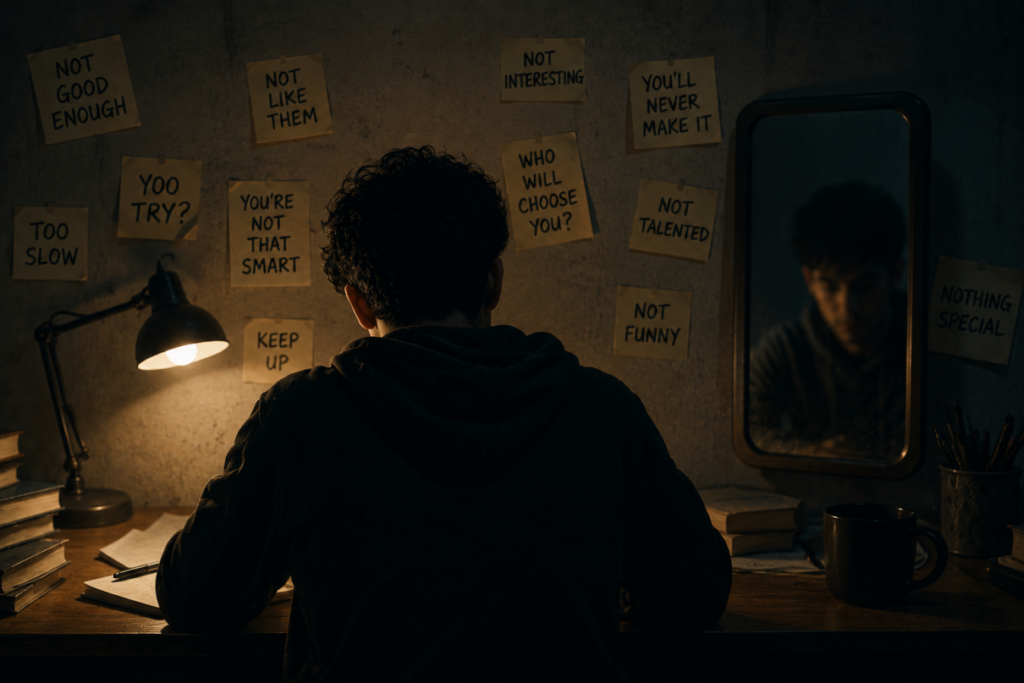
Think and decide if you agree on this. One bad comment can sit in your head for months – heck, even years, while ten compliments can disappear by breakfast. You can be told, “You’re really good at this,” so many times and still lie awake at night remembering the one person who said, “You’re not really that good are you?”
Ladies and gentlemen, we are strangely loyal to criticism.
Maybe because we are constantly looking sideways. And it might really be because we are subconsciously programmed that way. Like, when we are children, school teaches us to compare marks and ranks. Social media gives us numbers and defines us. Careers give us titles. People all around give us opinions. Somewhere between all of that, we quietly begin asking a very inconspicuous yet dangerous question: “How do I measure up?”
And once you start asking that question, there is always, and I mean ALWAYS, someone ahead of you.
Someone smarter. Someone with better looks. Someone with more friends, more money, more achievements, more confidence, better photographs, better hair (those of you who know) and, somehow, a LinkedIn profile that makes them look like they became CEO at fourteen.
So what do we do? We try to catch up.
We edit ourselves. We become quieter because someone found us annoying. We become louder because someone called us timid. We hide our interests because someone laughed at them. We chase achievements because somewhere along the way, achievements started feeling like the only proof that we were actually worth something.
And the cruelest part? It’s that the goalpost keeps moving.
You get the thing—mark, achievement, skill, or whatever you thought would finally make you feel enough—and then five minutes later, somebody else has something you don’t, and you’re already back to square one.
You know what? When I think about it, I’m actually reminded of the ugly duckling because my middle name (Hansika) means swan.
Everyone around it had already decided what it was – just different and wrong. And because everyone else seemed so certain, the duckling believed them.
Until it looked into the water. The reflection didn’t suddenly change.
The swan had been there the entire time. Only the eyes looking at it had changed.

Maybe we do something similar. We spend years looking at ourselves through borrowed eyes: the teachers who thought we weren’t smart enough, the friends who didn’t choose us, the teams that rejected us and the strangers who made careless comments.
And somehow, we let all of them sit on a jury and decide something they were never ever qualified to judge.
“Our worth”. And we can’t stop that. Because we can’t pause the world.
But what if you stopped?
What if you could be imperfect without treating imperfection as evidence against yourself? What if you could admit that you are still figuring things out without calling yourself a failure? What if you could walk into a room without needing everyone in it to like you?
You don’t have to become special/extraordinary before you are allowed to respect yourself.

You don’t have to win before you are worthy. You don’t have to be beautiful by somebody else’s definition, successful by somebody else’s timeline, or interesting according to somebody else’s standards.
Because there will always be someone who thinks you are too much. And someone who thinks you are not enough. You cannot build a self out of opinions that contradict each other. So perhaps the thing I have spent years trying to improve was never the problem. Perhaps I was simply looking at it incorrectly all along.
Because the most expensive thing I own isn’t my phone, my laptop, my clothes, or anything sitting in my room. It is the thing I have spent years trying to earn from other people.
My worth.
And the most ridiculous part? It was never up for sale. And it never will be.
No Responses